



1. What are hand-mixed Polyether Polyol chemicals?
1.1. Concept of Polyether Polyol
Polyether Polyol is a group of compounds containing many hydroxyl groups (-OH), widely used in the production of Polyurethane materials. In the rigid PU foam creation system, Polyol components are often combined with catalysts, surfactants, expanders and suitable additives to form a pre-prepared Polyol mixture.
When this mixture reacts with Isocyanate (ISO) in the designed ratio, a Polyurethane polymer network is formed along with the process of generating or releasing expanding gas. As a result, foam has a porous structure, often with a high percentage of closed cells, contributing to limiting heat transfer between the two environments.
1.2. The difference between the hand mixing system
Unlike the chemical system supplied through the pump line, the Polyether Polyol hand mixing system is designed with a reaction time that allows the construction worker to quantify, mix and pour directly. The process includes: quantification of Polyol and ISO; mix in correct technical ratio; Pour and wait for the foam to expand and stabilize.
The main advantage is versatility for localized items and cavity shapes that are difficult to handle with shaped insulation.

2. Insulation principle of PU foam in refrigeration systems
2.1. Closed cell structure helps limit heat transfer
PU foam after reaction contains many small porous cells with gas inside, limiting heat transfer when the closed cell structure is uniform. Thermal insulation effectiveness depends on the chemical composition, expanding agent, size and ratio of closed cells, density, thickness, temperature - humidity conditions and construction quality.
2.2. Limit water vapor condensation
Cold water in the Chiller system can cause the pipe surface to be below the air dew point, leading to condensation, corrosion or affecting the finish. PU foam helps increase thermal resistance; However, to effectively prevent condensation, it is necessary to combine a continuous vapor barrier system, seal the joints and choose the appropriate insulation thickness.
2.3. Contribute to improving energy efficiency
If the insulation is poor, environmental heat is transferred to the cold water, increasing the load that the chiller must handle. A properly designed and constructed insulation system contributes to maintaining water temperature, limiting distribution losses and improving energy efficiency. The specific savings level depends on configuration and operating conditions.
3. Outstanding characteristics of Polyether Polyol hand mixing system
3.1. Flexible construction, no need for industrial pumps
Construction workers use appropriate weighing equipment, mixing tanks and stirring tools instead of high-pressure PU machines. This is especially useful when repairing or adding insulation in hard-to-reach locations.
3.2. Ability to fill empty cavity
The reaction and expansion mixture helps fill voids in properly prepared cavities, such as elbows, transitions or equipment insulation. It is necessary to calculate the pouring volume and expansion pressure in the sealed cavity to avoid structural deformation.
3.3. Foam density is relatively stable
Density affects mechanical properties and raw material norms. Design density that is too low may not meet the requirements; Too high a density causes chemical waste. The two OVAL product lines have a reference foam density of about 43 kg/m³ or more.
3.4. Create shapes in complex positions
The pouring method creates foam right in the construction area, helping to handle uneven cavities and reduce voids if dosing, mixing, preparing molds and using correct techniques.
4. Hand-mixed Polyether Polyol lines at OVAL
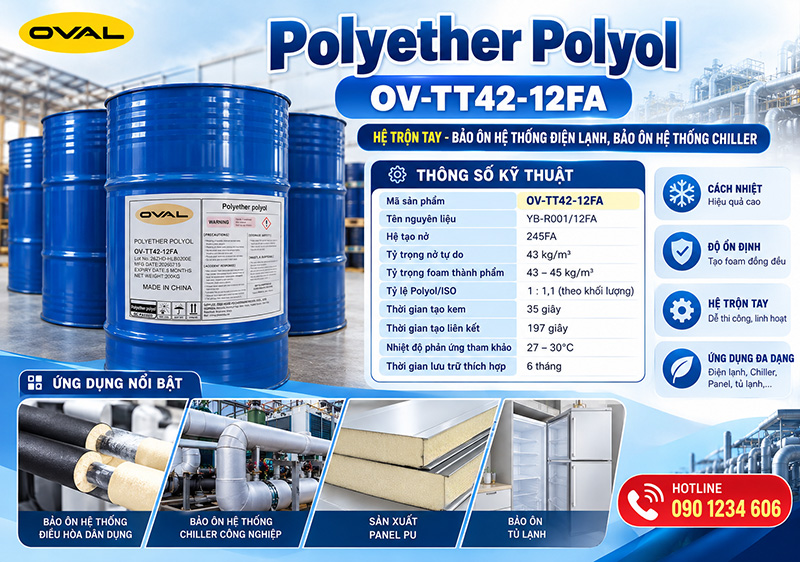
4.1. Polyether Polyol OV-TT42-12FA – System 245FA
OV-TT42-12FA uses the 245FA expansion agent system, designed for hand mixing and direct pouring. A relatively long bonding time can be advantageous when enough time is needed to get the mixture into the insulation chamber.
4.2. Polyether Polyol OV-TT45W – Water system
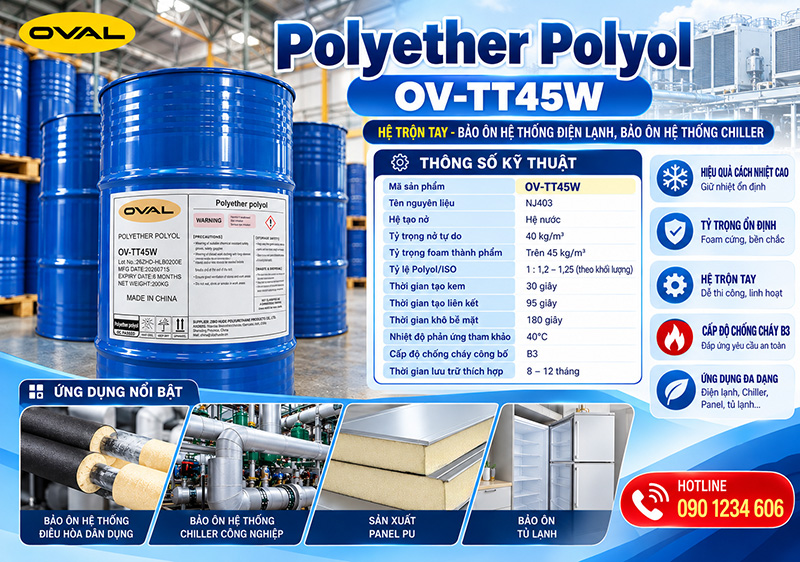
OV-TT45W is a water-based polyol used for hand mixing and pouring to create PU foam. The time to create reference links is shorter than OV-TT42-12FA, suitable for consideration for items requiring faster construction when construction conditions are met.
5. Application in chiller system insulation
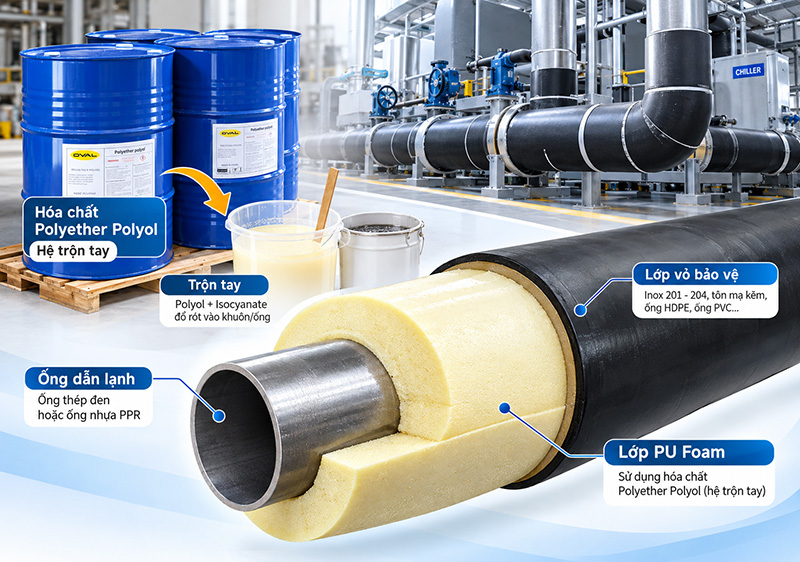
5.1. Insulate Chiller cold water pipes
Chillers are used in factories, commercial centers, hotels, hospitals and many central air conditioning projects. Cold water is sent from the Chiller cluster to the AHU/FCU. Hand-mixed PU foam can create an insulating layer in pipe sections with appropriate molds/covers, helping to limit heat from the environment transferred to the water.
5.2. Insulation of shrinks, elbows and connectors
Contractions, elbows, numbness and transitional positions are often difficult to install shaping materials. PU filling can assist in processing the corresponding cover cavities. Must ensure equipment maintainability, vapor barrier layer and joint tightness; Do not pour foam into parts that need to be operated or disassembled.
5.3. Repair and add insulation
When the insulation system is damaged due to impact, moisture or maintenance, local repair with suitable PU foam can be considered. Before adding, the cause must be treated, removed damaged material, cleaned surface and restored vapor barrier and outer protective layer.
6. Application in civil and industrial refrigeration insulation
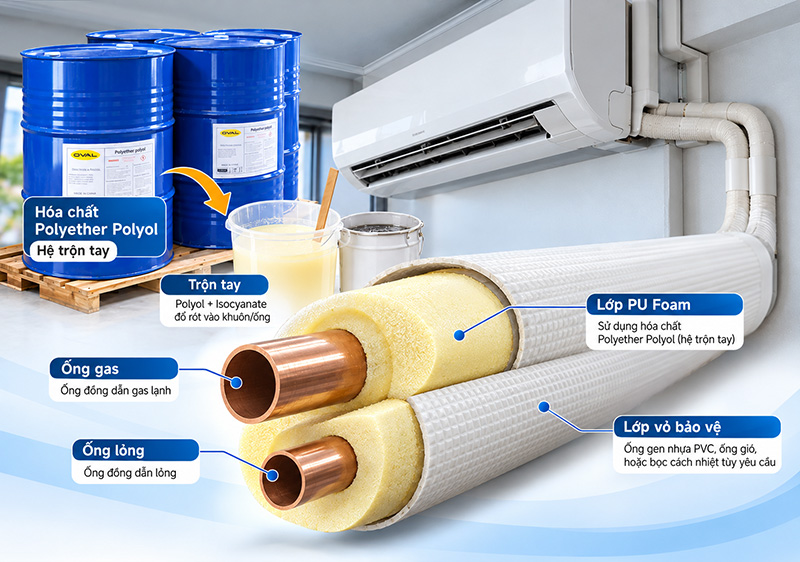
6.1. Insulate refrigeration pipes
The insulation layer limits heat exchange between the refrigerant or medium in the pipe and the environment. With a design that allows on-site foam creation, the hand mixing system can be used in the insulation compartment or local pipe section. Efficiency needs to be calculated according to temperature, thickness and vapor barrier requirements.
6.2. Insulate refrigeration equipment and insulate compartments
The mixture can be poured between the shells of properly designed equipment to create foam that helps limit heat transfer. Examples include technical compartments, insulation tanks and some refrigeration equipment components.
6.3. Insulating industrial equipment
Some tanks, equipment compartments and industrial structures need to limit heat exchange. However, it is necessary to determine the continuous working temperature and heat resistance limit of the PU system; It is not assumed that all types of foam are suitable for high temperatures.
7. Compare Polyether Polyol hand mixing system and pump system
|
Criteria |
Hand mixing system |
Pump system |
|
Method |
Mix and pour manually |
Dosing and mixing machine |
|
Equipment |
Scales, mixing tanks, stirring tools |
Specialized PU machine |
|
Scale |
Small and local |
Large or continuous |
|
Quantitative |
Depends on operation and weighing |
Can be automated |
|
Flexibility |
High in hard to reach places |
Depends on machine layout |
|
Application |
Local insulation, pouring on site |
PU panel, production line |
8. Instructions for using Polyether Polyol with hand mixing system
Step 1. Prepare the construction area
Check the surface is clean and dry, prepare a suitable insulation compartment, ensure ventilation and safety plan.
Step 2. Check ingredients
Confirm Polyol code, ISO compatibility, packaging, expiration date and raw material status; Do not use chemicals that are contaminated with water or degrade.
Step 3. Quantification of Polyol and ISO
Weigh the correct ratio by weight: OV-TT42-12FA about 1: 1.1; OV-TT45W approximately 1 : 1.2–1.25 according to technical instructions.
Step 4. Mix and pour
Mix using suitable equipment and then pour quickly into the prepared position. Calculate the cavity volume and expansion pressure in advance.
Step 5. Check quality
When the foam is stable, check the filling level and defects, then complete the vapor barrier system and protective layer before operating.
9. Important notes when constructing insulation with PU foam
Control chemical ratios
Wrong Polyol/ISO ratio can create foam that is soft, brittle, uneven or has poor performance.
Pay attention to the ambient temperature
Creaming and bonding time varies according to raw material temperature and environmental conditions; Need to test run according to instructions.
Control expansion pressure
Sealed compartments need to have appropriate volume design, air vents, filling volume and anti-deformation measures.
Ensuring chemical safety
ISO poses a risk of respiratory/skin irritation and sensitization. Contractors must comply with SDS/TDS, ventilate and use appropriate protection.
Store in the right conditions
The two Polyol lines have a recommended storage temperature of 18–25°C; OV-TT42-12FA is about 6 months and OV-TT45W is about 8–12 months when stored properly.
Conclusion
Hand-mixed Polyether Polyol chemicals are a flexible solution for creating rigid PU foam for many refrigeration insulation items and chiller systems. The ability to pour on-site and fill voids facilitates construction, maintenance or adding insulation in complex locations.
For sustainable effectiveness, it is necessary to choose the right Polyol system, control the mixing ratio, calculate the thickness and complete the vapor barrier system according to design. With OV-TT42-12FA and OV-TT45W, OVAL offers more material options for contractors and construction units.
CONTACT OVAL VIETNAM
Need advice on Polyether Polyol hand mixing system for Chiller pipes or refrigeration equipment? Contact OVAL for support in choosing chemical codes, mixing ratio instructions and quantity quotes.